
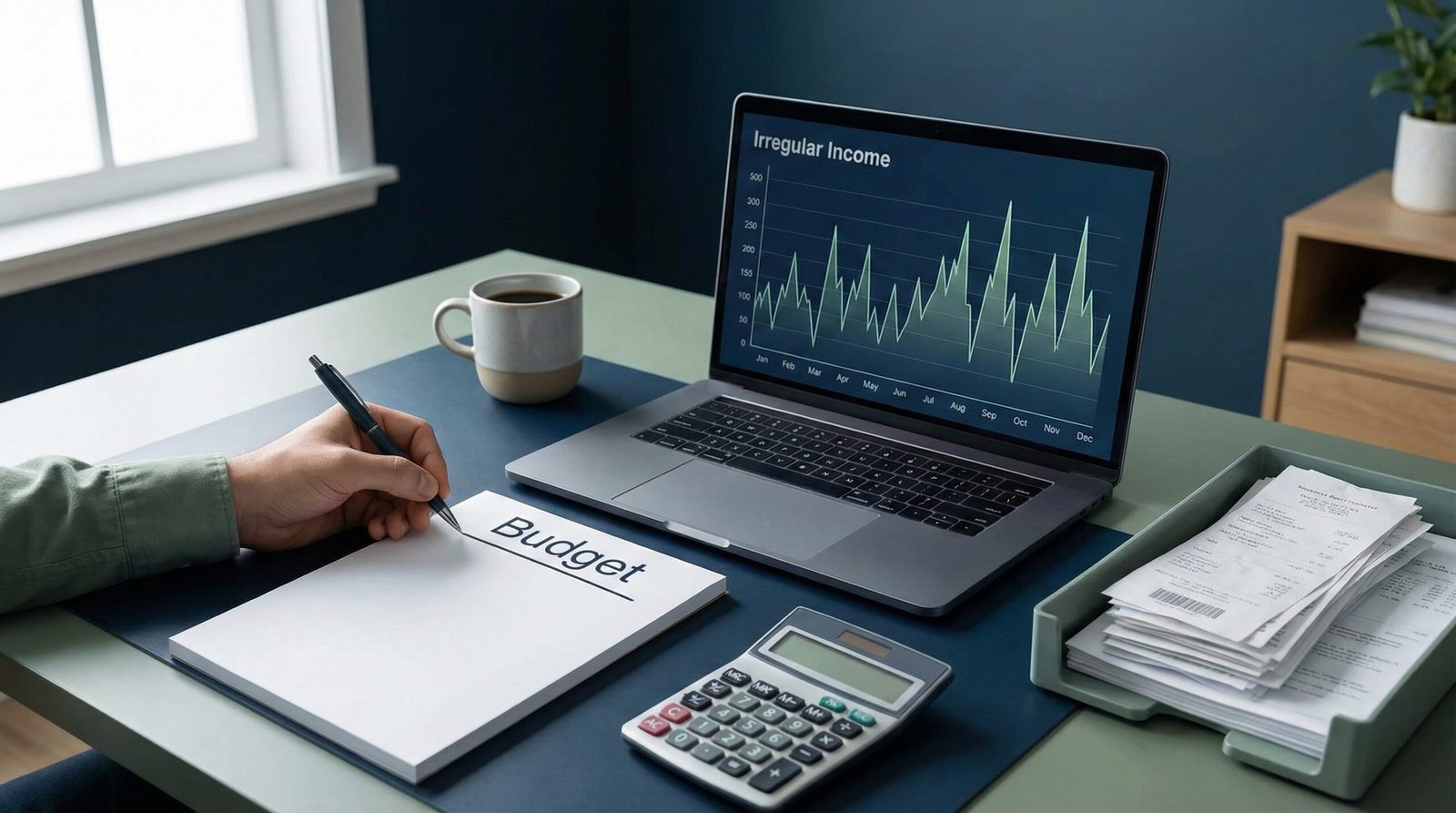
Budgeting on an irregular income requires calculating your essential monthly expenses and funding them using a conservative estimate of your lowest expected earnings. This approach ensures that mandatory bills are paid regardless of revenue fluctuations, reducing financial stress for freelancers, commission-based workers, and gig economy participants. Managing money without a consistent paycheck presents unique challenges, but specific strategies can stabilize cash flow and allow for long-term savings.
Key Takeaways:
- Calculate your “bare-bones” budget based on your lowest earning months, not your average.
- Utilize a “holding account” to smooth out income peaks and valleys.
- Prioritize building a larger emergency fund compared to fixed-income earners.
- Assign every dollar a job immediately upon receipt to prevent lifestyle creep.
1. Calculate Your Bare-Bones Monthly Expenses
A bare-bones budget consists of the absolute minimum amount of money required to cover your needs, excluding all wants and luxury spending. Establishing this number is the first critical step for variable-income earners.
You must separate non-negotiable costs from discretionary spending. Start by listing fixed obligations such as rent or mortgage, utilities, minimum debt payments, insurance premiums, and groceries. Do not include dining out, entertainment, or subscription services in this specific calculation. Knowing this “survival number” provides clarity on exactly how much cash you must generate to keep your household running.
Understanding the difference between essential and non-essential spending is vital. For a deeper dive into categorization, you can read about needs vs wants and how to control your spending. Once you identify your baseline number, you have a clear target to hit every month, regardless of how much revenue you bring in.
2. Determine Your Baseline Income Estimate
Your baseline income estimate is the lowest amount of money you can reliably expect to earn in a given month based on historical data. Relying on an average income can be dangerous because it may lead to overdrafts during lean months.
Review your bank statements or pay stubs from the last 12 months. Identify the month with the lowest income. Use this lowest figure as your budgeting baseline. For example, if your income fluctuated between $3,000 and $6,000 over the past year, build your primary budget around the $3,000 figure. This conservative approach ensures you can always cover your expenses.
Handling Income Above the Baseline
When you earn more than your baseline estimate, you must have a plan for the surplus. Do not view the extra money as immediate spending cash. Instead, allocate the overage toward specific financial goals, such as filling gaps in next month’s budget, funding a savings account, or making extra debt payments.
3. Create an “Income Holding” Account
An income holding account is a separate checking or savings account where all income is deposited before being transferred to your personal checking account. This strategy creates a buffer that mimics a regular paycheck.
Freelancers often struggle because they spend money as soon as it hits their account. To fix this, deposit every check, commission, or payment into the holding account first. Then, set up an automatic transfer of your “baseline income” amount from the holding account to your main checking account on the same day every month (e.g., the 1st or the 15th).
This method, sometimes called the “Hill and Valley” fund, smooths out the highs and lows. During high-income months, the holding account balance grows. During low-income months, you still pay yourself the same salary from the accumulated buffer in the holding account. This turns variable income into a steady, predictable “salary” that makes managing bills significantly easier.
4. Implement Zero-Based Budgeting
Zero-based budgeting is a method where you assign every single dollar of your income a specific purpose until you have zero dollars left unassigned. This technique is particularly effective for irregular incomes because it prevents money from disappearing into untracked spending.
When you receive your “salary” from your holding account, immediately allocate it to your budget categories. If you are new to this concept, learning how to create a monthly budget for beginners is a great starting point. The goal is to ensure that income minus expenses equals zero.
For variable income earners, the zero-based approach adjusts monthly. If your holding account allows you to pay yourself slightly more one month, you actively decide where that extra money goes—perhaps to a retirement fund or a sinking fund for car repairs—rather than letting it sit in your checking account where it might be spent impulsively. For more details on this specific method, review how the zero-based budget is explained simply for beginners.
5. Prioritize a Larger Emergency Fund
Variable-income earners need an emergency fund covering 6 to 9 months of expenses, compared to the standard 3 to 6 months recommended for salaried employees. The increased stability provides a safety net against income gaps or lost clients.
In a traditional job, an emergency fund covers job loss or unexpected bills. For freelancers or commission workers, the emergency fund also acts as a safeguard against a prolonged “dry spell” in work. According to the Consumer Financial Protection Bureau (CFPB), having liquid savings is the primary buffer against financial shocks. Start by saving 1 month of expenses, then aggressively build toward the 6-month mark using the surplus from your high-income months.
6. Plan for Taxes and Irregular Expenses
Self-employed individuals must set aside 25% to 30% of their net income for taxes immediately upon receipt of payment. Failing to save for taxes is the number one cause of debt for freelancers.
Treat the tax authority as your first bill. When a client pays you $1,000, immediately transfer $300 to a separate savings account labeled “Taxes.” Do not touch this money for operational costs or personal bills. Additionally, budget for irregular annual expenses like insurance premiums or software subscriptions by dividing the total annual cost by 12 and setting that amount aside monthly. This prevents large annual bills from destroying your cash flow in a single month.
7. Tracking Variable Income Effectively
Consistently tracking every invoice sent and payment received allows you to identify seasonal trends and predict future cash flow gaps. You cannot manage what you do not measure.
Use a spreadsheet or accounting software to log not just what you have been paid, but what you are owed (accounts receivable). This helps you anticipate when cash will actually land in your account. Identifying trends is crucial; for example, if you notice that January and February are historically slow months for your industry, you can save extra money in November and December to cover the shortfall.
| Category | Bare-Bones Need | High Month ($4,000) | Low Month ($2,500) |
|---|---|---|---|
| Rent/Housing | $1,200 | $1,200 | $1,200 |
| Utilities/Food | $600 | $600 | $600 |
| Tax Savings (30%) | $0 (Calc on Income) | $1,200 | $750 |
| Emergency Fund | $0 | $500 | $0 |
| Holding Account Buffer | $0 | $500 | $0 (Draw from Buffer) |
| Debt/Discretionary | $0 | $0 | -$50 (Cut back) |
8. Common Mistakes to Avoid
Lifestyle creep occurs when you increase your spending habits to match your highest earning months rather than maintaining your baseline budget. This is the most dangerous trap for irregular income earners.
When you have a record-breaking month, the temptation to upgrade your car or move to a better apartment arises. However, a high-income month is often followed by a correction or a low-income month. Maintain your standard of living based on your “bare-bones” numbers until your average baseline income has proven to be higher over a sustained period of 2 years or more. Official guidance from sources like USA.gov emphasizes the importance of living within your means to ensure long-term financial health.
Conclusion
Budgeting on an irregular income requires discipline, foresight, and a different structural approach than traditional budgeting. By establishing a bare-bones expense list, using a holding account to pay yourself a salary, and prioritizing a robust emergency fund, you can break the cycle of feast and famine. The goal is to decouple your spending from the timing of your deposits, granting you the stability of a paycheck with the freedom of flexible work.
Frequently Asked Questions
1. Can I stick to a budget if I don’t know how much I will make next month?
Yes, you can budget by using your lowest historical monthly income as your baseline. You plan your expenses based on this conservative number, ensuring your essential bills are covered even in a bad month, and treat any extra income as savings or debt repayment.
2. How much should I save for taxes if I am a freelancer?
Financial experts generally recommend saving 25% to 30% of your net income for taxes. This covers both income tax and self-employment tax. It is best to transfer this percentage to a separate savings account immediately every time you receive a payment.
3. Is the zero-based budgeting method good for variable income?
Yes, zero-based budgeting is highly effective for variable income because it forces you to allocate every dollar as it comes in. This prevents money from sitting idly in your account and ensures that high-income months are used to fund future goals or cover future low-income months.
4. What is a “hills and valleys” fund?
A hills and valleys fund is a savings buffer used to smooth out income fluctuations. You deposit high earnings into this fund during good months (hills) and withdraw from it to cover expenses during low-income months (valleys), creating a steady cash flow.
5. How large should my emergency fund be with irregular income?
You should aim for an emergency fund that covers 6 to 9 months of essential expenses. Because your income is not guaranteed, you face a higher risk of cash flow gaps compared to salaried employees, making a larger safety net necessary.